The AI Shift in Cyber Risk: Why Business Leaders Must Act Now
Five Eyes cybersecurity leaders have warned that AI is compressing attack timelines from years to months. Here is the practical agenda boards and executives should act on now.
By Tom Brennan

On June 22, 2026, the cybersecurity agencies of the Five Eyes alliance issued an unusually direct warning to business leaders around the world: artificial intelligence is fundamentally changing cyber risk, and organizations have months, not years, to adapt.
The joint statement, The AI Shift in Cyber Risk: Why Leaders Must Act Now, was signed by the heads of the United States’ CISA and NSA, the United Kingdom’s National Cyber Security Centre, Australia’s ASD, Canada’s CSE, and New Zealand’s GCSB. When these agencies speak with one voice, organizations should pay attention.
The timeline is not years, it is months.
The message is clear: cybersecurity is no longer an IT problem. It is a business risk, an operational resilience issue, and ultimately a boardroom responsibility.
For executives, directors, and business owners, the question is no longer whether AI will affect cybersecurity. The question is whether your organization is prepared for adversaries who are already using it.
Cyber Risk Has Become a Board-Level Issue
For years, many organizations treated cybersecurity as a technical function delegated to IT teams and security professionals. Technology leaders remain critical, but the Five Eyes agencies are signaling that delegation alone is no longer sufficient.
Cyber resilience now directly affects:
- Revenue and business continuity
- Regulatory and contractual compliance
- Customer and stakeholder trust
- Mergers, acquisitions, and enterprise value
- Cyber insurance eligibility and premiums
- Executive and board accountability
Simply having security controls in place is not enough. Leadership teams must understand whether those controls will perform under pressure during a real incident.
In my experience advising organizations across regulated industries, one of the most common challenges is the disconnect between what boards believe is protected and what security teams know remains vulnerable. That gap becomes significantly more dangerous as AI compresses the time between vulnerability discovery and exploitation.
CyberAdvisor and vCISO leadership help close that gap by translating technical exposure into decisions about operations, investment, accountability, and strategic risk.
The Window to Respond Is Shrinking
The most important takeaway from the Five Eyes statement is that AI is accelerating the speed, scale, and sophistication of cyberattacks.
Historically, organizations often had days, weeks, or even months to identify, test, and deploy patches after vulnerabilities were disclosed. That buffer is disappearing.
Threat actors are increasingly using AI to:
- Analyze newly disclosed vulnerabilities
- Generate proof-of-concept exploit code
- Automate reconnaissance and target selection
- Improve phishing and social engineering campaigns
- Scale attacks with less human involvement
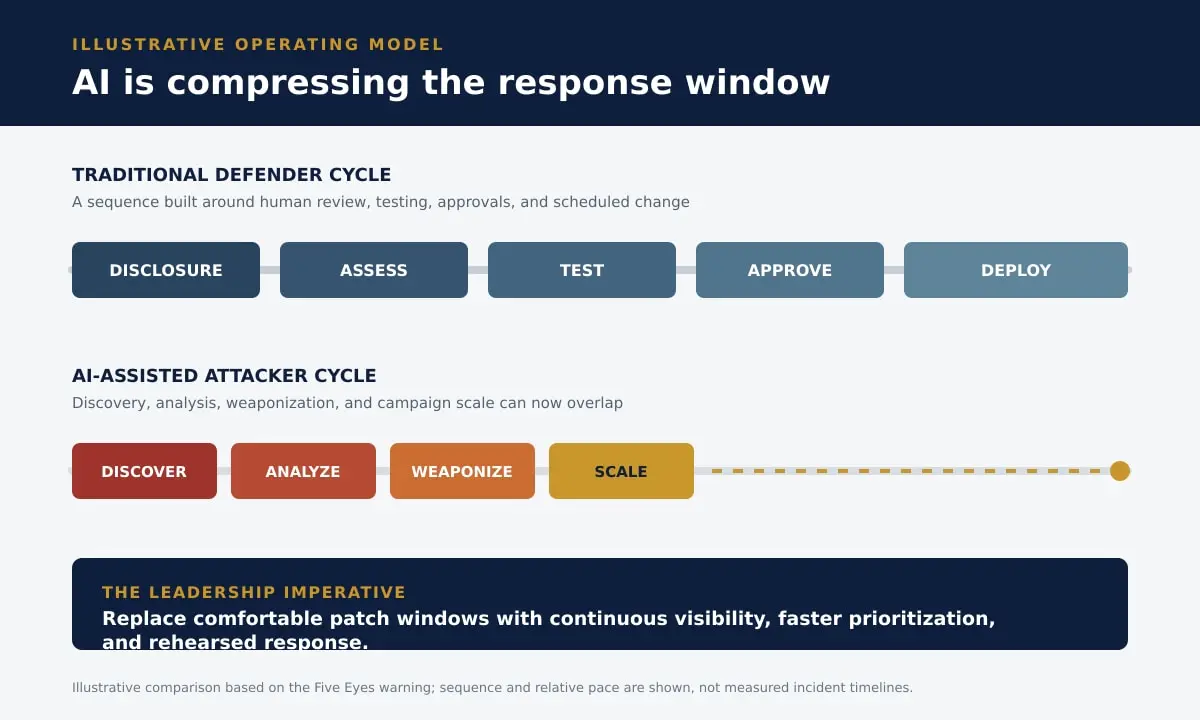
The visual above is an illustrative operating model, not measured incident data. It reflects the Five Eyes warning that AI is shortening the time between vulnerability discovery and exploitation.
An attacker equipped with AI can identify weaknesses, create exploit code, and launch campaigns faster than many organizations can complete a change-management meeting.
Organizations operating with manual patching processes, legacy technology, or limited security staffing face an increasingly difficult challenge: responding at human speed while adversaries operate at machine speed. Continuous monitoring through ManageIT/MSOC and risk-based prioritization through MEASURERISK help leadership focus limited time on the systems that matter most.
Nation-State Threats Are Already Here
The Five Eyes warning did not emerge in a vacuum.
Just days before the statement was published, NCSC CEO Dr. Richard Horne disclosed that the agency had managed more than 200 cyber incidents affecting the United Kingdom’s critical national infrastructure and supporting ecosystem in the year to May 2026. Around 75% were believed to be linked to state actors. He specifically warned that Russia, China, and Iran are increasingly targeting the systems that underpin essential services.
This is not a future concern. The threat environment described by government agencies is the environment organizations are operating in today.
Organizations supporting government, defense, critical infrastructure, manufacturing, healthcare, financial services, and supply-chain operations should assume that sophisticated adversaries are actively evaluating potential pathways into their environments.
For organizations within the Defense Industrial Base and those pursuing CMMC readiness, this reality reinforces the importance of treating cybersecurity as a strategic business function rather than a compliance exercise.
The Five Actions Every Organization Should Prioritize
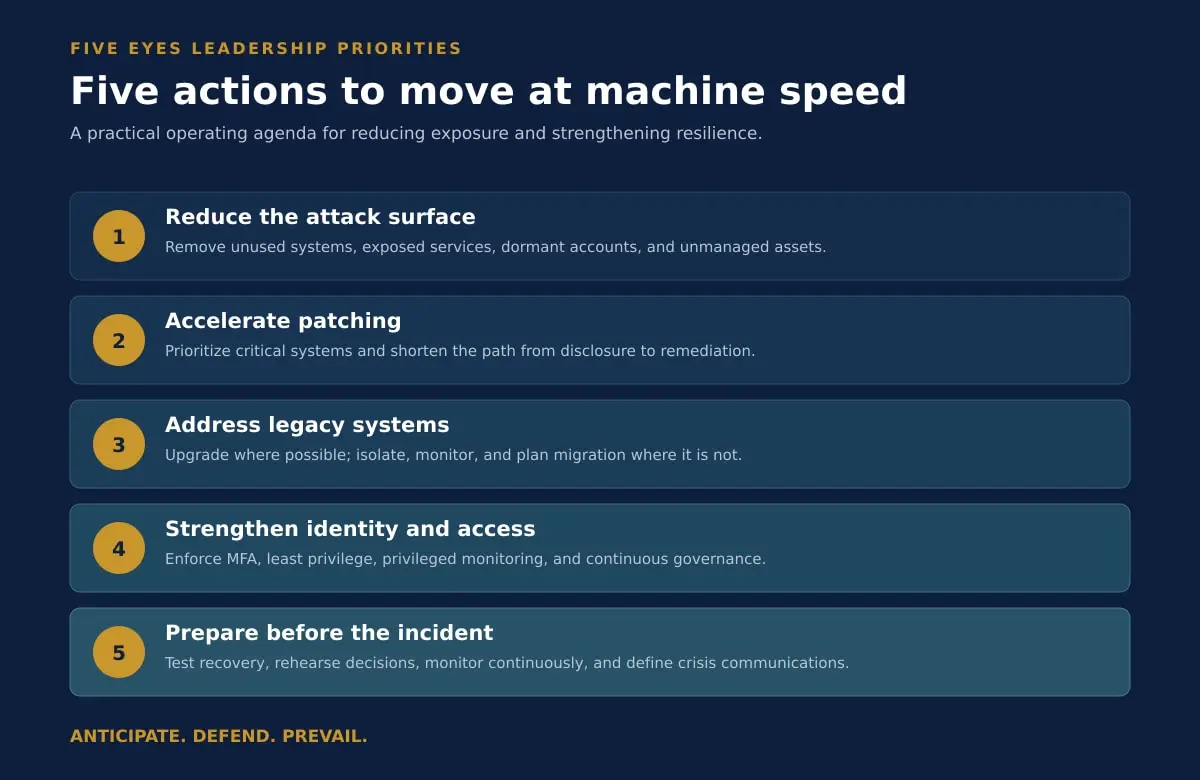
The Five Eyes agencies intentionally kept their recommendations simple and actionable.
1. Reduce Your Attack Surface
Every unnecessary application, exposed service, dormant account, and unmanaged asset creates risk. Organizations should maintain accurate asset inventories, eliminate unused systems, and continuously monitor for external exposure.
CATSCAN® helps validate how an attacker could move across cyber, physical, and social pathways instead of relying only on a checklist of controls.
2. Accelerate Patching
Slow patch cycles are becoming increasingly dangerous. Security teams should prioritize vulnerability management programs that focus on business-critical systems and reduce the time from disclosure to remediation.
This does not mean patching every system blindly. It means connecting asset criticality, threat intelligence, exposure, and operational constraints so the most consequential risk moves first.
3. Address Legacy Systems
Unsupported operating systems and aging applications are no longer merely technical debt. They have become strategic liabilities.
If a legacy platform cannot be upgraded, leadership should require compensating controls, isolation, enhanced monitoring, a named owner, and a formal migration roadmap.
4. Strengthen Identity and Access Management
Identity has become the new perimeter. Organizations should enforce multi-factor authentication, least-privilege access, privileged account monitoring, conditional access policies, and continuous identity governance.
Many successful attacks begin with compromised credentials rather than sophisticated malware. Microsoft cloud and identity hardening reduces preventable gaps, while FraudShield™ helps employees recognize the increasingly convincing social engineering AI can produce.
5. Prepare for Incidents Before They Happen
No organization can realistically expect to prevent every breach. The differentiator is how quickly an organization can detect, contain, and recover.
Effective preparation includes incident response plans, tabletop exercises, disaster recovery testing, continuous security monitoring, third-party response partnerships, and executive crisis communication planning.
CyberTrain gives executives and departments a safe environment to rehearse difficult decisions before an actual disruption. Cyber resilience is not measured by whether an incident occurs. It is measured by how effectively the organization responds.
AI Creates Both Opportunity and Risk
One aspect of the statement deserves particular attention: it treats AI as a dual-use capability.
The Five Eyes agencies are not merely warning organizations about AI-powered attacks. They are encouraging organizations to use AI deliberately for defense. Security teams should explore how AI can improve:
- Threat detection and behavioral monitoring
- Vulnerability discovery and prioritization
- Security operations efficiency
- Incident response analysis
- Risk reporting for executives and boards
At the same time, organizations must manage the risks created by AI adoption itself. AI-generated software, shadow AI usage, sensitive data exposure, over-privileged agents, and poorly governed automation can create new attack surfaces if left unmanaged.
The organizations that succeed will be those that embrace AI securely rather than avoiding it altogether. That requires ownership, policy, approved use cases, access controls, logging, vendor review, and ongoing validation — the same operating discipline applied to every other consequential technology.
What This Means for Business Leaders
The Five Eyes statement is ultimately a warning about urgency. Organizations can no longer assume they have years to modernize their security programs. The gap between attacker capability and defender readiness is narrowing rapidly, and AI is accelerating that trend.
For boards, executives, and business owners, the immediate priorities are:
- Assess cyber risk at the business level.
- Validate security controls against real-world threats.
- Modernize or contain legacy technology.
- Strengthen identity security.
- Invest in resilience and incident response capabilities.
- Develop a deliberate strategy for secure AI adoption.
Organizations that view cybersecurity as a compliance checkbox will increasingly struggle to keep pace with both regulators and adversaries. Those that treat cybersecurity as a core business capability will be better positioned to protect operations, customers, reputation, and long-term growth.
Turn the warning into an operating plan
Proactive Risk helps regulated organizations assess cyber readiness, reduce operational risk, strengthen resilience, and build security programs aligned with today’s evolving threat landscape.
Schedule a complimentary Risk Briefing with a senior advisor →
The AI shift is already underway. The question is not whether change is coming, but whether your organization is ready for it.
Proactive Risk
See Around Corners™