ISO 42001 Is Becoming a Business Expectation. Make Your Next 120 Days Count.
Our response to A-LIGN: how a focused 120-day CyberAdvisor vCISO engagement can turn AI governance intentions into accountable action—not a certification guarantee.
By Tom Brennan
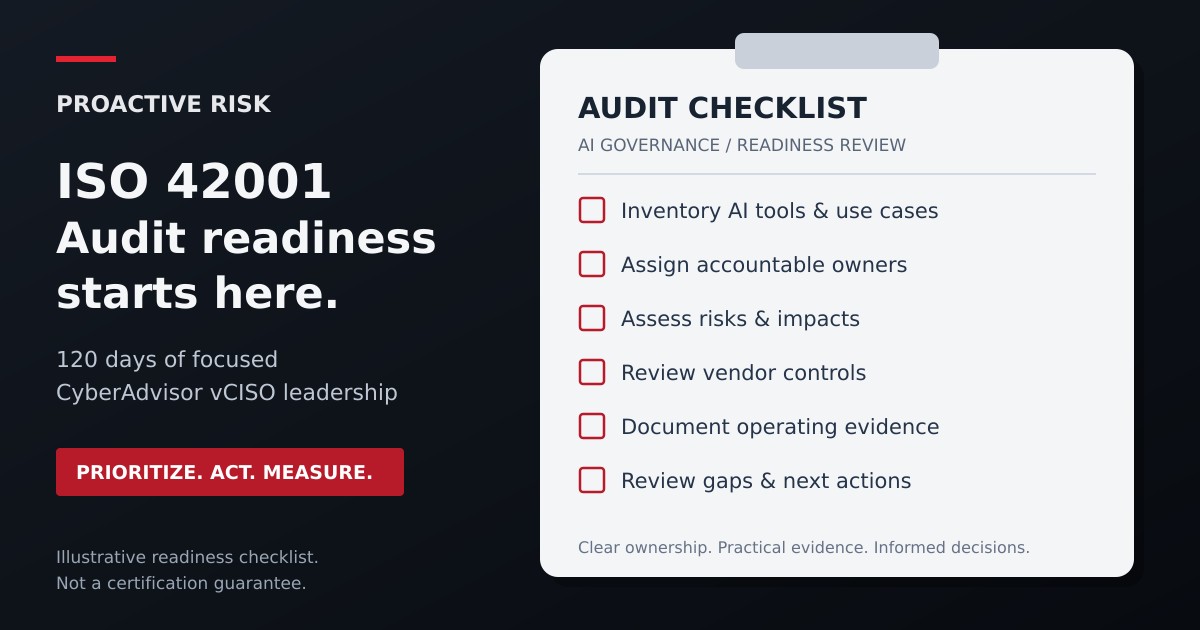
Why a focused CyberAdvisor vCISO engagement can help turn AI governance intentions into accountable action.
Our affiliate partner A-LIGN makes an important argument in “Why ISO 42001 Is About to Become Table Stakes”: customers increasingly want evidence that their vendors can manage AI responsibly—not simply assurances that governance is on the roadmap.
We agree.
Author Rick Orloff describes a shift that business leaders should take seriously. As AI becomes part of everyday operations, questions about its oversight are becoming questions about trust, procurement, and revenue.
Where does customer data go? Who approves an AI tool? What happens when a vendor changes its underlying model? Who is accountable when an automated decision creates a problem?
Those questions need more than a policy document. They need leadership.
A 120-day engagement with Proactive Risk’s CyberAdvisor vCISO service provides a focused way to establish priorities, coordinate the work, and give executives a clearer basis for their next decision.
Agreement on the direction—not a promise that certification solves everything
A-LIGN’s article makes a distinction worth emphasizing: ISO/IEC 42001 is a management-system standard, not a guarantee that every AI-related risk has been eliminated.
An AI management system helps establish governance, responsibilities, risk assessment, documentation, and continual improvement. But organizations still need operational controls appropriate to their actual use of AI.
A certificate does not replace access controls, monitoring, vendor oversight, or incident response. Nor does adopting a framework automatically demonstrate compliance with every applicable law.
The objective should be a functioning program that supports the business—not a collection of documents that nobody uses.
That aligns with our approach:
Security isn’t about eliminating every risk. It’s about using intelligence to make better operational decisions, prioritize the risks that matter most, and focus finite resources where they will have the greatest impact.
Why start with 120 days of vCISO leadership?
Many organizations already have capable IT teams, an MSP, security products, and compliance responsibilities. What they may lack is a designated leader connecting those activities to executive priorities.
AI makes that coordination harder. Purchasing decisions can originate in marketing, finance, HR, operations, or individual departments—not just IT. Responsibility can become fragmented before leadership realizes how widely AI is being used.
CyberAdvisor provides fractional security leadership to help bring those decisions together.
A 120-day engagement creates a defined period to answer four business questions:
- What AI-related exposure do we actually have?
- Which risks and customer requirements deserve attention first?
- Who owns the necessary decisions and improvements?
- What evidence will demonstrate progress?
The engagement should support your internal team and existing providers, not replace them or duplicate work they already perform.
A practical framework for the first 120 days
The following illustrates how an engagement can be structured. Specific activities and deliverables depend on the agreed scope, organizational maturity, and availability of your team.
Days 1–30: Understand the business and establish the baseline
Start with how AI is actually being used—not how leadership assumes it is being used.
Initial work can include identifying AI tools and use cases, understanding sensitive-data flows, reviewing vendor arrangements, and gathering the AI-related questions customers are asking.
Existing security and compliance work matters, too. Organizations with established programs should identify what can be reused and where AI introduces additional responsibilities.
The value: a clearer view of exposure, ownership, and business priorities before committing resources to solutions.
Days 31–60: Set priorities and assign accountability
Not every AI use case carries the same risk. An internal drafting assistant and a system influencing employment or customer eligibility decisions should not receive identical treatment.
CyberAdvisor can help leadership prioritize risks, establish decision owners, and define practical requirements for AI approval, acceptable use, vendor review, and escalation.
This is also the time to evaluate whether ISO/IEC 42001 certification supports your customer expectations and business strategy.
The value: a defensible plan that distinguishes urgent action from work that can reasonably wait.
Days 61–90: Put the agreed controls into practice
Policies become useful when people know how to apply them.
Depending on scope, this phase can support implementation of approval processes, staff guidance, vendor-review practices, incident-response procedures, and evidence collection. Your IT team, legal advisers, business owners, and service providers remain essential participants.
The vCISO’s role is to coordinate priorities and help leadership address obstacles—not simply distribute another checklist.
The value: progress that can be demonstrated through operating practices, assigned responsibilities, and documented decisions.
Days 91–120: Review progress and decide what comes next
Leadership needs an honest assessment of what changed, what remains incomplete, and which risks still require a decision.
An executive review can summarize completed work, outstanding gaps, resource requirements, and recommendations for the next phase. If certification is a business priority, that discussion can inform readiness planning and engagement with an independent certification provider such as A-LIGN.
The value: a clearer investment decision and a practical path forward, rather than an open-ended statement that AI governance remains “on the roadmap.”
Advisory leadership and independent certification serve different purposes
Proactive Risk’s role is to help your organization understand risk, establish priorities, and coordinate improvement.
A certification provider independently evaluates the management system within the applicable certification scope and process. These roles should remain distinct.
A 120-day CyberAdvisor engagement is not a promise of ISO/IEC 42001 certification in 120 days. Certification timing depends on scope, maturity, implementation, evidence, and independent assessment.
The immediate value is having experienced leadership help your organization make progress that is appropriate to its risks and resources.
Give your sales team an answer the business can support
A-LIGN is right to connect AI governance with commercial expectations.
When a prospect asks how you manage AI risk, your sales team should not have to improvise. It should be able to describe approved practices, identify accountable owners, and provide evidence appropriate to the request.
That does not guarantee a contract. It does help replace vague assurances with a more credible conversation.
Start with a focused consultation
You do not need to resolve every AI risk before taking the first step. You need to understand where you stand and decide what deserves attention next.
What could your organization accomplish in 120 days with a designated security leader coordinating AI governance, customer requirements, and risk priorities?
Schedule a consultation about a 120-day CyberAdvisor vCISO engagement.
We’ll discuss your current environment, business objectives, and whether a focused engagement is the right next step.
This article responds to Rick Orloff’s “Why ISO 42001 Is About to Become Table Stakes,” published by our affiliate partner A-LIGN. The proposed 120-day approach describes Proactive Risk’s perspective, not an A-LIGN delivery commitment or certification guarantee.